Lemuria
The Continent
Long before the oceans claimed the south, a vast landmass connected India to Madagascar and Australia. This legendary cradle of Tamil civilization—Kumari Kandam—was the birthplace of the ancient Siddhar lineage, Adimurai martial systems, and the cosmic science of the 108 Varmam points.
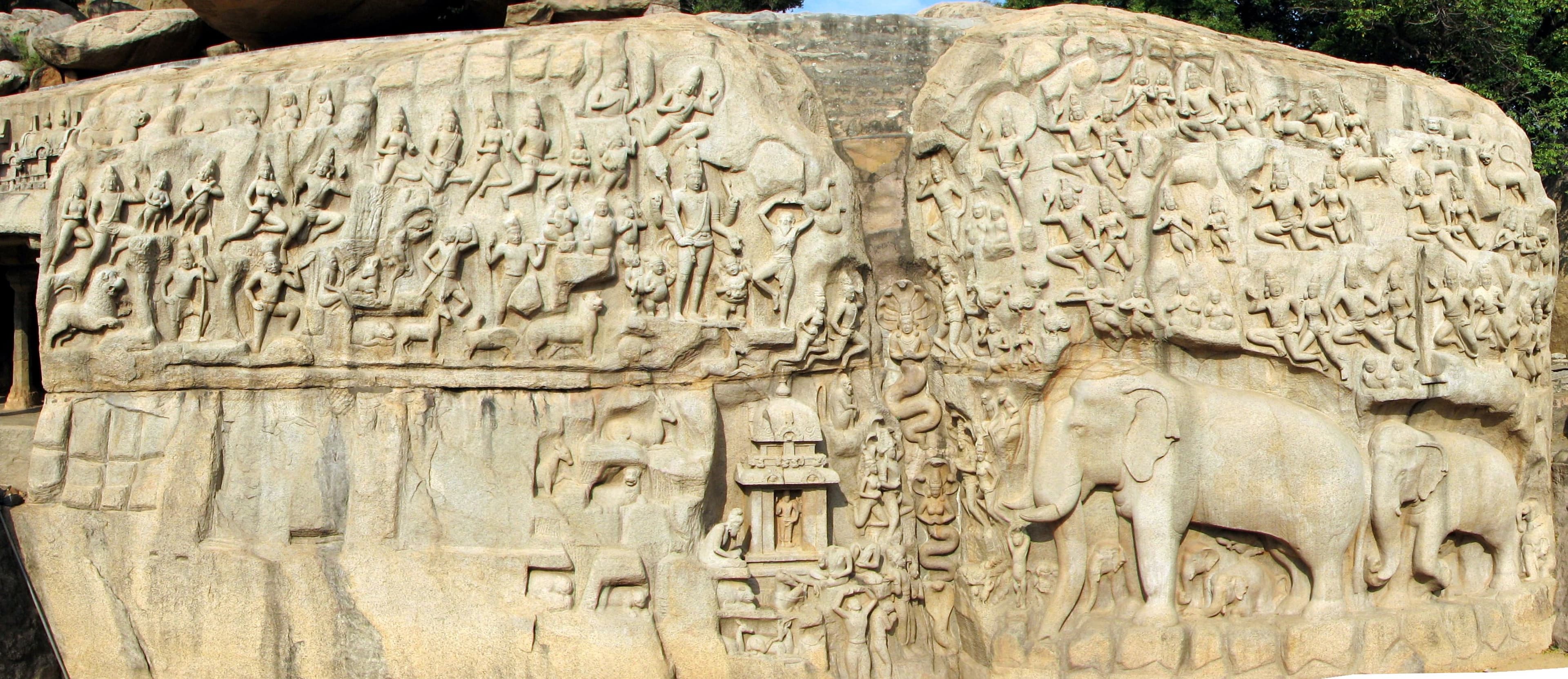
Rock Carving: "Descent of the Ganges" (Arjuna's Penance) at Mamallapuram, Tamil Nadu. A 7th-century Pallava monument capturing the ancient Dravidian martial postures and cosmic alignment.
The Calligraphic Heritage of Tamil
This authentic palm-leaf manuscript preserves ancient Tamil letters, demonstrating the remarkable variety and design of classical Dravidian scripts. From early Tamizhi (தமிழி) script to the curvilinear Vatteluttu (round writing) and classical Tamil character forms, the evolution of Tamil writing reflects both artistic elegance and functional adaptation.
Because writing on dry palmyra leaves required scratching with an iron stylus, horizontal lines were avoided to prevent splitting the leaf along its natural grain. This structural constraint birthed the beautiful, flowing round letterforms that define classical Tamil writing today.

Historical Artifact: An original Palm-Leaf Manuscript (Olai Chuvadi) illustrating the calligraphic beauty of ancient Tamil scripts used to document poetry, medicine, and spiritual sciences.
Scientific Carbon Dating Milestones
To map the chronological timeline of ancient Tamil literacy, metalwork, and urbanization, researchers utilize Accelerator Mass Spectrometry (AMS) radiocarbon dating on organic materials. The results provide scientific benchmarks that substantiate classical Sangam literature descriptions.
Charcoal & Inscribed Potsherds
Pushed the Sangam Era and the origin of the Tamizhi (தமிழி) script back to the 6th Century BCE. It scientifically proves that a highly literate, urbanized society existed in South India contemporary with the Gangetic plains' second urbanization.
Rice Husks inside Burial Urns
Confirmed that the Porunai River Valley civilization is at least 3,200 years old, verifying the deep antiquity of agricultural and settlement systems mentioned in classical Sangam literature.
Charcoal from Iron implement layers
Pushed the onset of the Iron Age in India back to 4,200 years ago. It proves that the ancient Dravidian culture had developed advanced metallurgical skills much earlier than previously assumed.
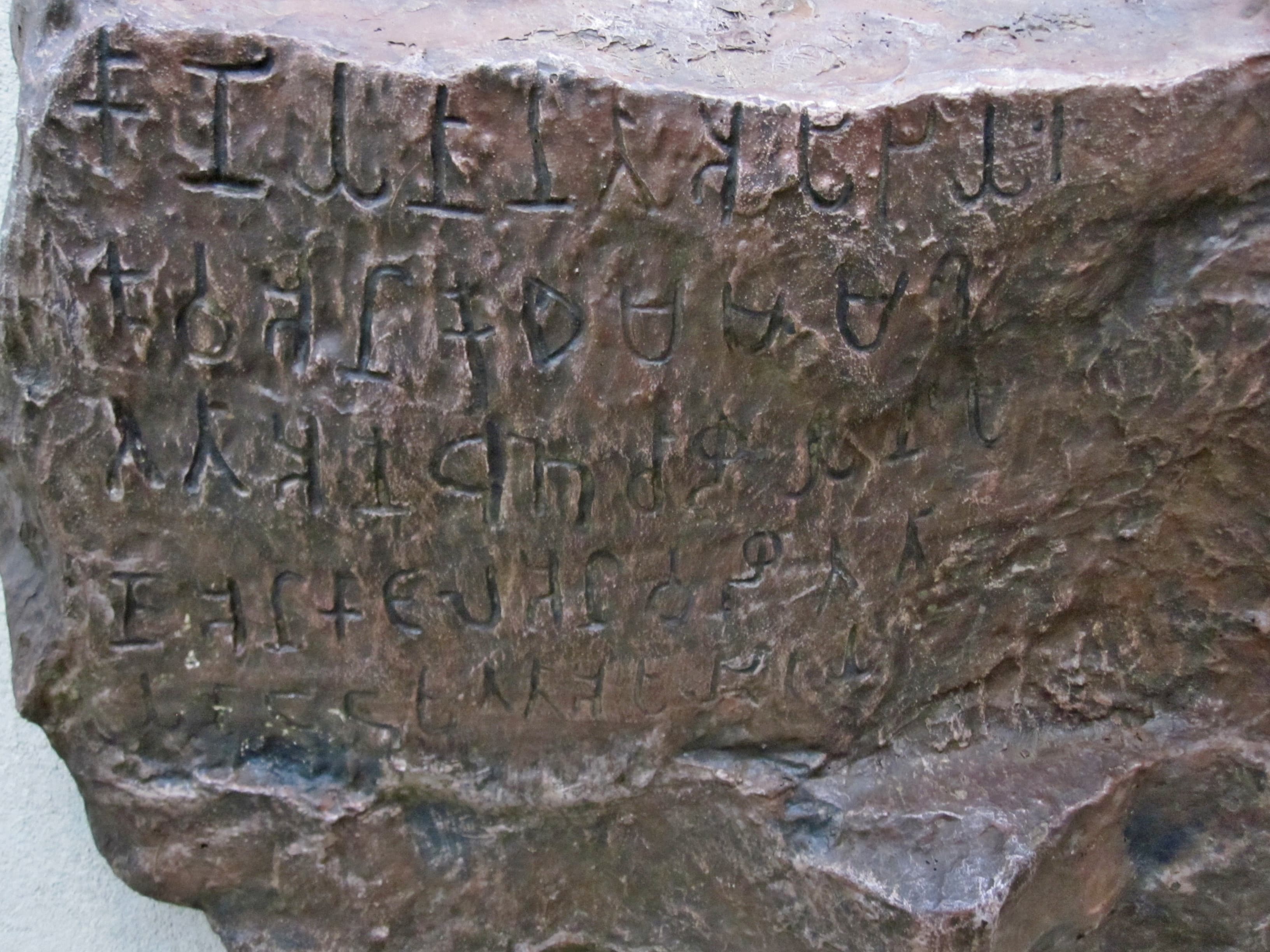
Historical Artifact: Replicated model of the Mangulam rock-cave inscription in Tamil Nadu, illustrating the oldest surviving Tamizhi (தமிழி) script.
The Mangulam Cave Inscriptions (3rd Century BCE)
The rock inscriptions found at Mangulam (near Madurai, Tamil Nadu) are recognized as the **oldest surviving epigraphical records** of the Tamizhi script, dating back to around 300 BCE.
Carved into the overhanging rock-brows of natural caves used by Sangam-era Jain ascetics, these inscriptions record gifts and cave dedications made by the legendary Pandyan king Nedunchezhiyan (நெடுஞ்செழியன்) and his generals. They represent the first time a Pandyan monarch is historically documented by name in physical stone.
Two Perspectives, One Ancient Legend
Tracing the roots of the Lemurian hypothesis and its integration into classical Tamil lineage.
Philip Sclater & The 19th Century
Scientific Hypothesis & SupersessionIn 1864, English zoologist **Philip Sclater** published an article titled *“The Mammals of Madagascar”* in the *Quarterly Journal of Science*. Sclater noted a peculiar biogeographical distribution: fossils of lemurs and their close relative primates were abundant in both Madagascar and India, yet completely absent in the intervening regions of the Middle East and mainland Africa.
To explain this anomaly within the scientific framework of the era, Sclater proposed that a massive, now-sunken land bridge once stretched across the Indian Ocean, facilitating primate migration over millions of years. He named this theoretical landmass **"Lemuria"** after the primates whose distribution inspired the idea.
Sclater's hypothesis gained significant traction throughout the late 19th century, drawing endorsements from prominent scientists like Ernst Haeckel, who speculated that Lemuria might have been the ancestral cradle of the human species.
However, in the mid-20th century, the discovery of **plate tectonics** and Alfred Wegener's theory of **continental drift** rendered the land bridge hypothesis obsolete. Geologists proved that Madagascar and India were once part of the ancient supercontinent Gondwana and separated via tectonic movement rather than sinking beneath the sea.
Kumari Kandam & Tamil Revival
Integration of Modern Science & Sacred TextsWhile Western science moved past Lemuria, the concept found a powerful second life in India. In the late 19th and early 20th centuries, Tamil national revivalists, facing British colonial rule and northern cultural assertions, were seeking to establish the ancient antiquity and independent origin of Tamil culture.
Scholars like **Suryanarayana Sastri** (Parithimar Kalaigar) and **J. Nallasami Pillai** integrated the Western scientific theory of "Lemuria" with indigenous legends of lands lost to ocean deluges (referred to as *KadalKOL* in ancient texts). They equated Sclater's Lemuria with the legendary **Kumari Kandam**, a massive landmass that lay south of modern Kanyakumari.
In classical Tamil texts such as the *Silappatikaram* and commentaries on the grammar text *Iraiyanar Akapporul*, mention was made of ancient Pandyan territories swallowed by the sea. Equating these accounts with Western geological theories allowed Tamil scholars to present their cultural history as scientifically validated.
Kumari Kandam was thus characterized as a paradise of high learning, where Tamil was spoken in its purest form, and where the first two **Sangams** (literary academies) flourished under royal patronage before being swallowed by rising sea levels at the close of the last glacial period.
Literary Evidence of the Lost Land
The memory of Kumari Kandam is not a modern fabrication; it is recorded across several layers of classical Tamil poetry. In the epic **Silappatikaram** (one of the Five Great Epics of Tamil Literature), the poet describes how the raging sea swallowed the Pahruli river and the mountainous Kumari range, forcing the Pandyan king to conquer new territories on the mainland to compensate for his lost lands.
"The raging ocean swallowed the Pahruli river and the Kumari peaks with their multi-layered forests. The Pandyan King, to compensate for his lost land, marched west and conquered the lands of the Ganga and the Himalaya..."— Silappatikaram, Kadaladukadhai (Lines 17-22)
Similarly, the **Kalittokai** (one of the Eight Anthologies of Sangam literature) recounts how the ocean swallowed the lands of the Pandyas, who then migrated northward and established Madurai on the banks of the Vaigai river. Commentaries by Nakkeerar on the *Iraiyanar Akapporul* contain the most detailed account of the Three Sangams, recording the names of hundreds of poets, the kings who patronized them, and the vast span of thousands of years over which they composed.
In the medieval puranic text **Kanda Puranam**, the continent is referred to as *Kumari Kandam*, divided into nine distinct administrative provinces, with the Kumari river flowing through its center. These consistent geographical and historical references suggest that massive sea-level rise (possibly corresponding to the meltwater pulses of post-glacial warming) remained deeply engraved in the oral and written history of the Tamil people.
Silappatikaram
Describes the geographical loss of the Pahruli and Kumari river basins to the ocean, triggering the northern expansion of the Pandyan kingdom.
Iraiyanar Akapporul
The commentary by Nakkeerar which preserves the chronological records of the first two Sangams in Then Madurai and Kapatapuram before the ocean deluges.
Kanda Puranam
A 14th-century Sanskrit-derived text that designates the southern territory as "Kumari Kandam", confirming the endurance of the name across centuries.
The Discovery of the Mauritia Microcontinent
While the classical legend of Kumari Kandam remains a cultural memory, modern oceanography and geophysics have recently uncovered physical evidence of submerged continental fragments underneath the Indian Ocean, proving that parts of Gondwana indeed lay hidden beneath the volcanic seafloor.
The 2013 Discovery (Nature Geoscience)
An international team of geoscientists led by **Trond H. Torsvik** (University of Oslo) and including **Nick Kusznir** (University of Liverpool) published the seminal paper "A Precambrian microcontinent in the Indian Ocean" in Nature Geoscience. They identified ancient zircon crystals (660M to 2B years old) in Mauritius beach sand, suggesting a buried Precambrian microcontinent they named Mauritia.
The 2017 Confirmation (Nature Communications)
In 2017, a follow-up study led by geologist **Lewis D. Ashwal** (University of the Witwatersrand) and published in Nature Communications titled "Archaean zircons in Miocene oceanic hotspot rocks establish ancient continental crust beneath Mauritius" discovered 3-billion-year-old zircons embedded directly inside solid volcanic rock, proving the microcontinent lay deep in the bedrock.
Scientific Release Summary
- Torsvik, T. H., et al. (2013). "A Precambrian microcontinent in the Indian Ocean." Nature Geoscience, 6(3), 223-227.
- Ashwal, L. D., et al. (2017). "Archaean zircons in Miocene oceanic hotspot rocks establish ancient continental crust beneath Mauritius." Nature Communications, 8, 14086.
Mauritia formed a land bridge connecting Madagascar and India during the Gondwana supercontinent era. As the plates drifted apart roughly 61 to 83.5 million years ago, Mauritia was stretched, fragmented, and eventually sank beneath the basaltic lava flows of the forming Indian Ocean.
The Three Sangams
The First Sangam
Established under the patronage of Makirtti and subsequent Pandyan kings, and presided over by Sage Agastya. This was the legendary epoch where Tamil grammar, literature, and the core pressure-point files of Varmam were synthesized.
The Second Sangam
As the first ocean deluge claimed Then Madurai, the academy moved east. Siddhars gathered to rewrite, refine, and catalog the arts of warfare, weapon defense, and structural healing.
The Third Sangam
Following the second cataclysm, the survivors founded the third academy on the mainland. The secret martial syllabus was dispersed among select royal lineages to prevent extinction.
The Cosmic Microcosm
The Palm Leaf Manuscripts
Ancient Tamil scriptures such as 'Varma Choodamani' and 'Varma Odivu Murivu' detailed the positioning, vulnerability, and therapeutic stimulation of all 108 points.
The 108 Structural Junctions
A reflection of the cosmos: the body was mapped as a matrix of 12 Major (Padu) and 96 Minor (Thodu) junctions of life-breath (Prana).
Siddhar Agastya
Revered as the patron saint of Tamil language and medicine, who first recorded these methods to heal warriors injured in combat.
The Lemuria VAWO Mission
The Lemuria Varmakalari Adimurai World Organization (Lemuria VAWO) is dedicated to preserving the absolute purity of these ancient teachings. Our lineage preserves the oral transmissions, ancient combat routines, and pressure-point medicine exactly as they were carried north from Kumari Kandam.
Through academic structures, physical verification, and traditional master-disciple lineages, we safeguard a science that was once lost to the rising seas.