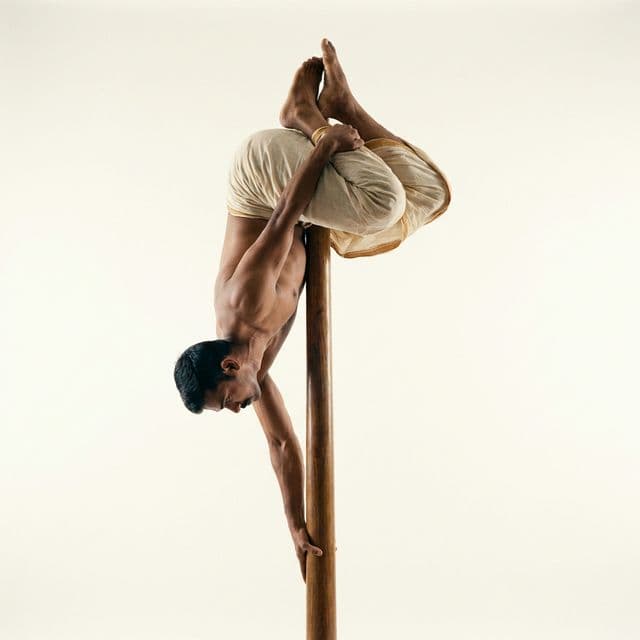
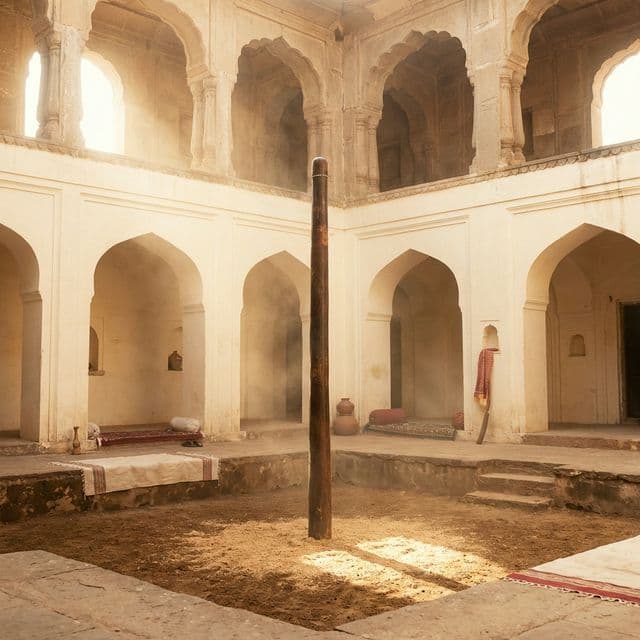
Experience the gravity-defying art of Mallkhamb. A traditional Indian sport where gymnasts perform aerial yoga and wrestling grips on a vertical wooden pole or rope.
Where Mallakhamb comes from, how it became a national sport, and how training is supervised.
Mallakhamb at a glance
The name
Malla (wrestler) + khamb (pole)
Also written
Mallakhamb, Mallakhamba, Mallkhamb
Earliest mention
Manasollasa, 1135 CE
Forms
Pole, hanging and rope
National body
Mallakhamb Federation of India (1981)
Last reviewed
01
What is Mallakhamb?
Mallakhamb is an Indian discipline of holds, balances and acrobatic postures performed on a vertical wooden pole or a hanging rope. Its name joins malla, a wrestler, and khamb, a pole: it began as the wrestler's training pole. In Tamil it is sometimes called mallar kambam, and in English it is spelled several ways — Mallakhamb, Mallakhamba and Mallkhamb among them.
02
Where it comes from
The earliest literary mention is in the Manasollasa, a Sanskrit text of 1135 CE written by the Western Chalukya king Someshvara III. The modern revival is credited to Balambhatta Dada Deodhar, teacher to the Peshwa Baji Rao II, who renewed interest in it in the late eighteenth century.
03
Mallakhamb today
Mallakhamb was demonstrated at the 1936 Olympic Games in Berlin. National championships followed, the Mallakhamb Federation of India was founded in 1981, and Madhya Pradesh declared it the state sport in 2013. The first World Mallakhamb Championship was held in Mumbai in 2019.
04
What training builds
Every hold depends on grip, strength through the whole body, flexibility and balance, and the concentration to join them in a sequence. For martial artists it complements the footwork and conditioning of Silambam and Adimurai.
05
How training is supervised
Mallakhamb is taught progressively, and each new skill is earned on the one before it.
Students learn mounts, grips, balance locks and dismounts in order, under an instructor.
Practice happens over protective matting, with spotters for new skills.
The pole is kept smooth and oiled, traditionally with castor oil, so it can be gripped safely.
Ask the team about age, fitness and any health requirements before joining.
04Pole, hanging, rope
The three formsof Mallakhamb
Competition recognises three forms. They share holds and postures, but each apparatus asks something different of the athlete.
Pole, hanging and rope Mallakhamb compared by apparatus, movement and main demand
Aspect
Pole
Hanging
Rope
Apparatus
A fixed, upright wooden pole, set in the ground
A shorter pole suspended from above, free to swing
A cotton rope hung from above
Movement
Climbs, grips, balances and postures on a stable base
The same skills on a pole that moves under the athlete
Wraps, locks and postures held in the rope
Main demand
Grip strength and balance
Control and balance on a moving base
Flexibility and holds
Pole
Apparatus
A fixed, upright wooden pole, set in the ground
Movement
Climbs, grips, balances and postures on a stable base
Main demand
Grip strength and balance
Hanging
Apparatus
A shorter pole suspended from above, free to swing
Movement
The same skills on a pole that moves under the athlete
Main demand
Control and balance on a moving base
Rope
Apparatus
A cotton rope hung from above
Movement
Wraps, locks and postures held in the rope
Main demand
Flexibility and holds
Rise on the pole
Mallakhamb startson the ground
Every student begins with grips, mounts and balance, under an instructor and over matting. Ask the team about the next session.
Mallakhamb is an Indian discipline of holds, balances and acrobatic postures performed on a vertical wooden pole or a hanging rope. The name joins malla (wrestler) and khamb (pole): it began as a training aid for wrestlers.
Where did Mallakhamb originate?
In India. The earliest literary mention is in the Manasollasa of 1135 CE, by the Western Chalukya king Someshvara III, and the modern revival is credited to Balambhatta Dada Deodhar, teacher to the Peshwa Baji Rao II.
What are the types of Mallakhamb?
Three are practised in competition: pole Mallakhamb on a fixed upright pole, hanging Mallakhamb on a suspended pole, and rope Mallakhamb on a hanging cotton rope.
What is a Mallakhamb pole made of?
A smooth hardwood such as teak or sheesham (Indian rosewood), kept oiled — traditionally with castor oil — so that it can be gripped safely. A competition pole stands about 2.6 metres tall and tapers from about 55 cm round at the base to about 35 cm at the top.
How tall is a Mallakhamb pole?
A competition pole stands about 2.6 metres tall and tapers from about 55 cm round at the base to about 35 cm at the top. Training poles can differ; your instructor will start you on the right apparatus.
Is Mallakhamb an Olympic sport?
No. It was demonstrated at the 1936 Olympic Games in Berlin, and today has national championships in India and a world championship, first held in Mumbai in 2019.
Who can learn Mallakhamb?
Training is progressive and supervised, so students start with the basics whatever their background. Ask the team about age, fitness and health requirements before joining.
How do I enquire about training?
Use the Classes page to contact the team. Confirm instructor supervision, equipment, eligibility and current availability before attending.