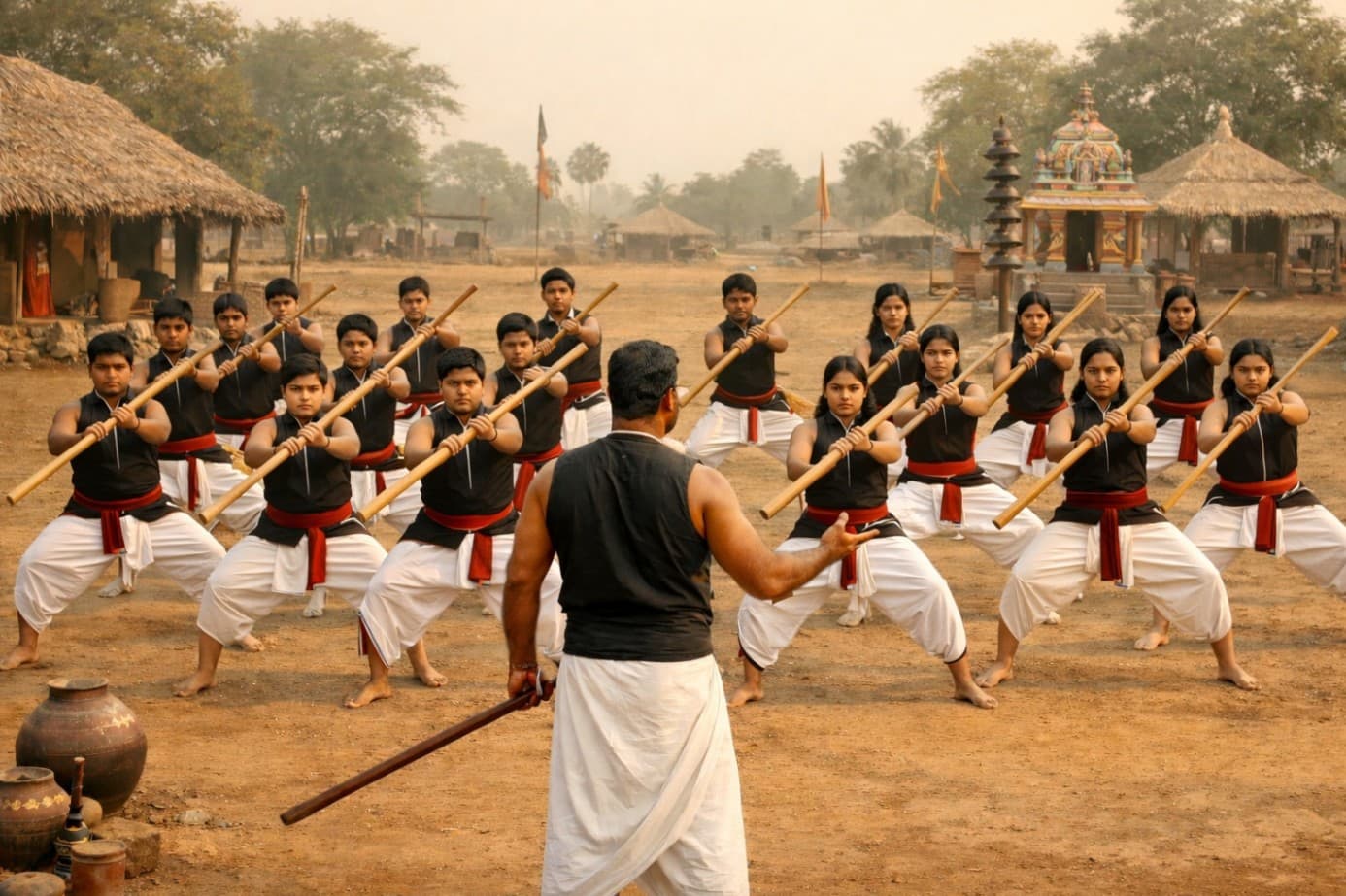
Silambam is the Tamil martial art of the staff: footwork patterns and continuous spinning, striking and guarding sequences with a bamboo kambu. Lemuria VAWO teaches it in Kanyakumari, with trial classes for students and masters.
The wider system adds other traditional weapons, such as maankombu and the aruval, and an unarmed component, kuttu varisai. At Lemuria VAWO it is taught alongside Adimurai, the empty-hand art, as one path from the first class.
Before you start
The kambu is traditionally cut to reach about your forehead. You do not need your own for the first class.
Trial classes are held for students and masters. Book a place and the team will call you.
Where the art comes from, the staff and how it is sized, how training progresses, and how to start.
Silambam at a glance
In Tamil
சிலம்பம் (Silambam)
What it is
The Tamil art of the staff
The staff
Kambu, traditionally bamboo, cut to about forehead height
Unarmed side
Kuttu varisai
Named in
Classical Tamil literature, including the Silappatikaram
Where we teach
Thaikalam, Kanyakumari District
Trial classes
For students and masters
Last reviewed
01
Where Silambam comes from
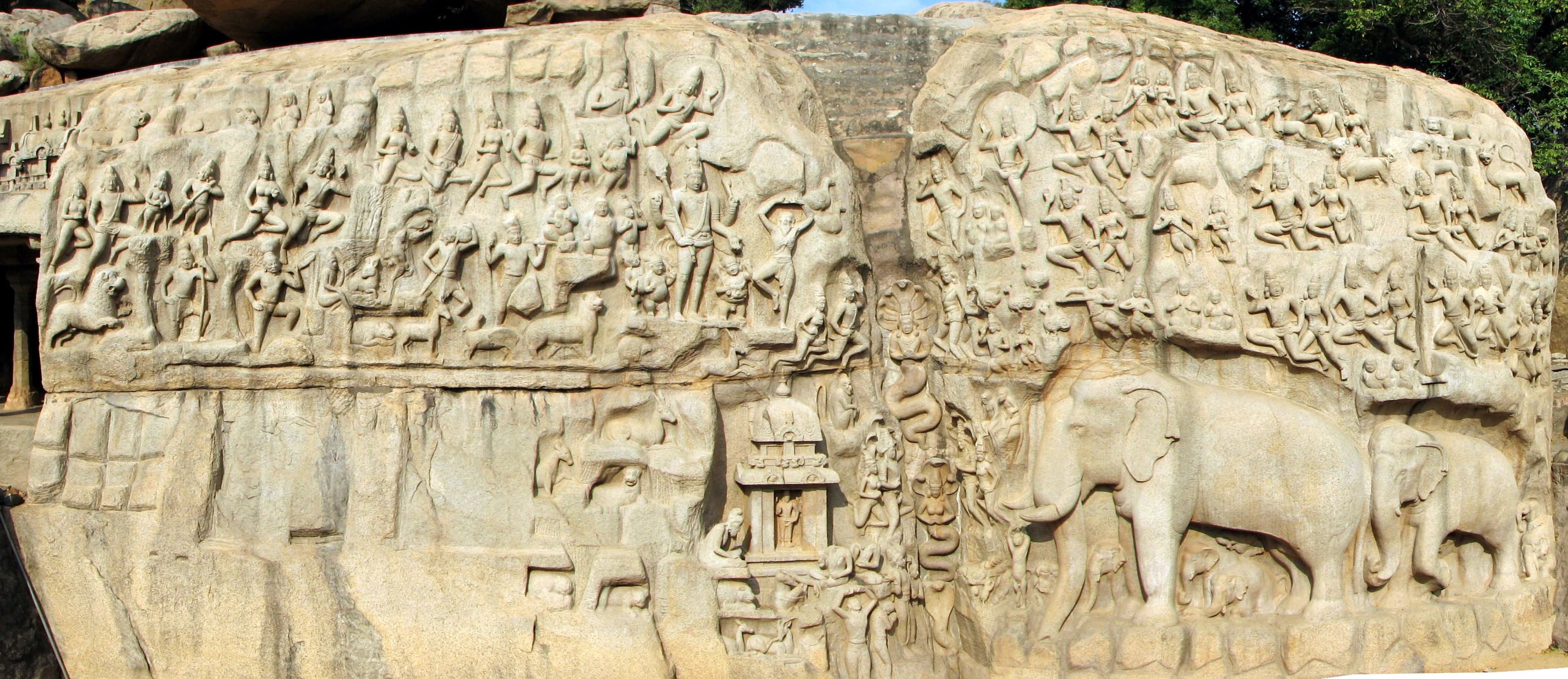
Silambam is the staff art of Tamil Nadu. It is named in classical Tamil literature, and the Silappatikaram, one of the great Tamil epics, is often cited for its mention of silambam staves among the goods traded at its ports.
The art travelled with the Tamil diaspora, and Tamil communities practise it well beyond India, notably in Malaysia, as well as across Tamil Nadu.
02
The staff: the kambu
The staff is the kambu, traditionally cut from bamboo. Standing upright, it reaches about the forehead of the person who wields it, so a staff is chosen for its owner rather than bought in one size. Weight and balance matter as much as length, and your instructor will advise on both before you buy.
03
Footwork: the foundation of everything
Silambam is built on footwork. Stepping patterns, chuvadu, are learned before speed or power is added, because every spin, strike and guard is carried by the feet. A student who rushes the footwork finds the staff work never settles.
04
How the staff work progresses
At Lemuria VAWO, staff training moves through clear stages:
The grip and single strikes, slowly and with control.
Spins: continuous rotation of the staff around the body, in both hands.
Sequences that join footwork, strikes, spins and guards.
Partner work at a controlled pace, with distance and timing.
Other weapons of the wider system, once the staff is secure.
05
Weapons beyond the staff
The wider Silambam system includes other traditional weapons, among them maankombu (deer horns, also called maduvu), the aruval and the sword. They are taught after the staff, because the footwork and timing they need are learned with it. The Lemuria Shop sells several of these weapons for students whose instructor has introduced them.
06
Kuttu varisai: the empty hand
Silambam has an unarmed component, kuttu varisai, practised as sequences of strikes, blocks and footwork. At Lemuria VAWO the empty hand is taught through Adimurai, the lineage's striking art, alongside the staff.
07
What regular training builds
Students who practise steadily commonly notice:
Coordination and timing, from spinning a staff while stepping in pattern.
Strength in the grip, wrists, shoulders and legs.
Awareness of distance, which is the root of self-defence.
Focus and patience, from drilling a sequence until it is clean.
08
Starting Silambam at Lemuria VAWO
No experience is needed. Trial classes are held for students and for masters (asans) of the arts; book a place and the team will call you to confirm the batch. Wear loose clothing, bring water, and tell your instructor about any injury before you start. You do not need your own staff for the first class.
03Side by side
Silambam, Adimurai& Kalaripayattu
Three arts of the far south, often confused. Here is how they differ, and which of them Lemuria VAWO teaches.
Silambam, Adimurai and Kalaripayattu compared by home region, core, main tool, vital-point study and whether Lemuria VAWO teaches them
Aspect
Silambam
Adimurai
Kalaripayattu
Home region
Tamil Nadu and the Tamil world
Kanyakumari and Tirunelveli, and south Kerala
Kerala
Core
The staff: footwork, spins, strikes and guards
The empty hand: strikes, kicks, blocks, locks and escapes
Body conditioning, weapons and empty-hand combat
Main tool
The kambu, with other weapons later
The body, unarmed
Several weapons and the body
Vital points
Studied at the advanced stage, as varmam
Varma adi, at the advanced stage
Marma, within its own tradition
At Lemuria VAWO
Taught from the first class
Taught from the first class
Not taught: a separate system
Silambam
Home region
Tamil Nadu and the Tamil world
Core
The staff: footwork, spins, strikes and guards
Main tool
The kambu, with other weapons later
Vital points
Studied at the advanced stage, as varmam
At Lemuria VAWO
Taught from the first class
Adimurai
Home region
Kanyakumari and Tirunelveli, and south Kerala
Core
The empty hand: strikes, kicks, blocks, locks and escapes
Main tool
The body, unarmed
Vital points
Varma adi, at the advanced stage
At Lemuria VAWO
Taught from the first class
Kalaripayattu
Home region
Kerala
Core
Body conditioning, weapons and empty-hand combat
Main tool
Several weapons and the body
Vital points
Marma, within its own tradition
At Lemuria VAWO
Not taught: a separate system
This reflects how the Lemuria lineage sees the three arts; other schools describe them differently.
04Glossary
Words ofthe staff
The Tamil terms a Silambam student hears in the first months of training.
Silambamசிலம்பம்
The Tamil art of the staff. Practice is built on footwork patterns and continuous spinning, striking and guarding sequences.
Kambuகம்பு
The Silambam staff. It is traditionally cut so that, standing upright, it reaches about the forehead of the person who wields it.
Chuvaduசுவடு
A footwork pattern. The stepping sequences of Silambam and Adimurai are learned as chuvadu before speed or power is added.
Kuttu varisaiகுத்து வரிசை
The unarmed component of the Silambam system, practised as sequences of strikes, blocks and footwork.
Maankombuமான் கொம்பு
Deer horns: a traditional weapon of two horns joined at their bases and held at the centre, also called maduvu. It belongs to the wider Silambam system and is taught once the staff is secure.
Aruvalஅரிவாள்
A heavy curved blade of rural Tamil Nadu, a farm tool that the martial tradition also trains with. The veecharuval (வீச்சரிவாள்) is a longer form made for swinging.
Asanஆசான்
A teacher or master of the martial arts. Students learn from an asan in person, and the lineage is traced through its asans.
Kalariகளரி
A traditional training ground. Varmakalari, in the organisation's name, joins varmam (the vital points) with kalari.
Pick up the staff
Trial classesfor students and masters
No experience is needed. Book a place, and the team will call you to confirm where and when the next trial batch meets.
Silambam is the Tamil martial art of the staff, from Tamil Nadu. Practice is built on footwork patterns and continuous spinning, striking and guarding sequences with a bamboo staff called the kambu, and the wider system includes other traditional weapons and an unarmed component, kuttu varisai.
What does the word Silambam mean?
The name is usually traced to the bamboo of the hill country, from which the staff is traditionally cut. The art is named in classical Tamil literature, including the Silappatikaram.
How long should a Silambam stick be?
Traditionally, a Silambam staff standing upright reaches about the forehead of the person who wields it. Weight and balance matter too, so ask your instructor before you buy one.
What is a Silambam stick made of?
Traditionally bamboo, chosen for being light, strong and slightly flexible. Your instructor will advise on the staff that suits your height and stage of training.
What weapons are used in Silambam?
The staff comes first. The wider system includes maankombu (deer horns, also called maduvu), the aruval and the sword, taught once the staff is secure, and an unarmed component called kuttu varisai.
Is Silambam the same as Kalaripayattu?
No. Silambam is the Tamil art of the staff; Kalaripayattu is the martial art of Kerala, with its own forms, weapons and marma tradition. The two grew up side by side in the far south of India and share some vocabulary, but they are separate systems.
Is Silambam good for self-defence?
Silambam trains distance, timing, footwork and awareness, which are the foundations of self-defence. That ability comes from regular, supervised practice over months, not from a few classes.
Can children learn Silambam?
Ask the team about the class you have in mind. Age requirements are set for each class and camp, a parent or guardian's consent is needed, and training is supervised.
Where can I learn Silambam in Kanyakumari?
Lemuria VAWO teaches Silambam from Thaikalam, its home ground near Marungoor in Kanyakumari District, with classes listed on the Classes page. Beginners are welcome.
Are there trial Silambam classes?
Yes. Lemuria VAWO holds trial classes for students and for masters (asans). Use Book a trial class on this page, and the team will call you to confirm where and when the next trial batch meets.
Where can I buy a Silambam stick?
Wait for your instructor's advice on length and weight first. The Lemuria Shop's buying guide at shop.lemuriavawo.org/guide explains how to choose a staff; check the shop for what is in stock.